4G LTE Layer 2 Protocols
byRahul Kaundalon
4G Layer 2 Protocols
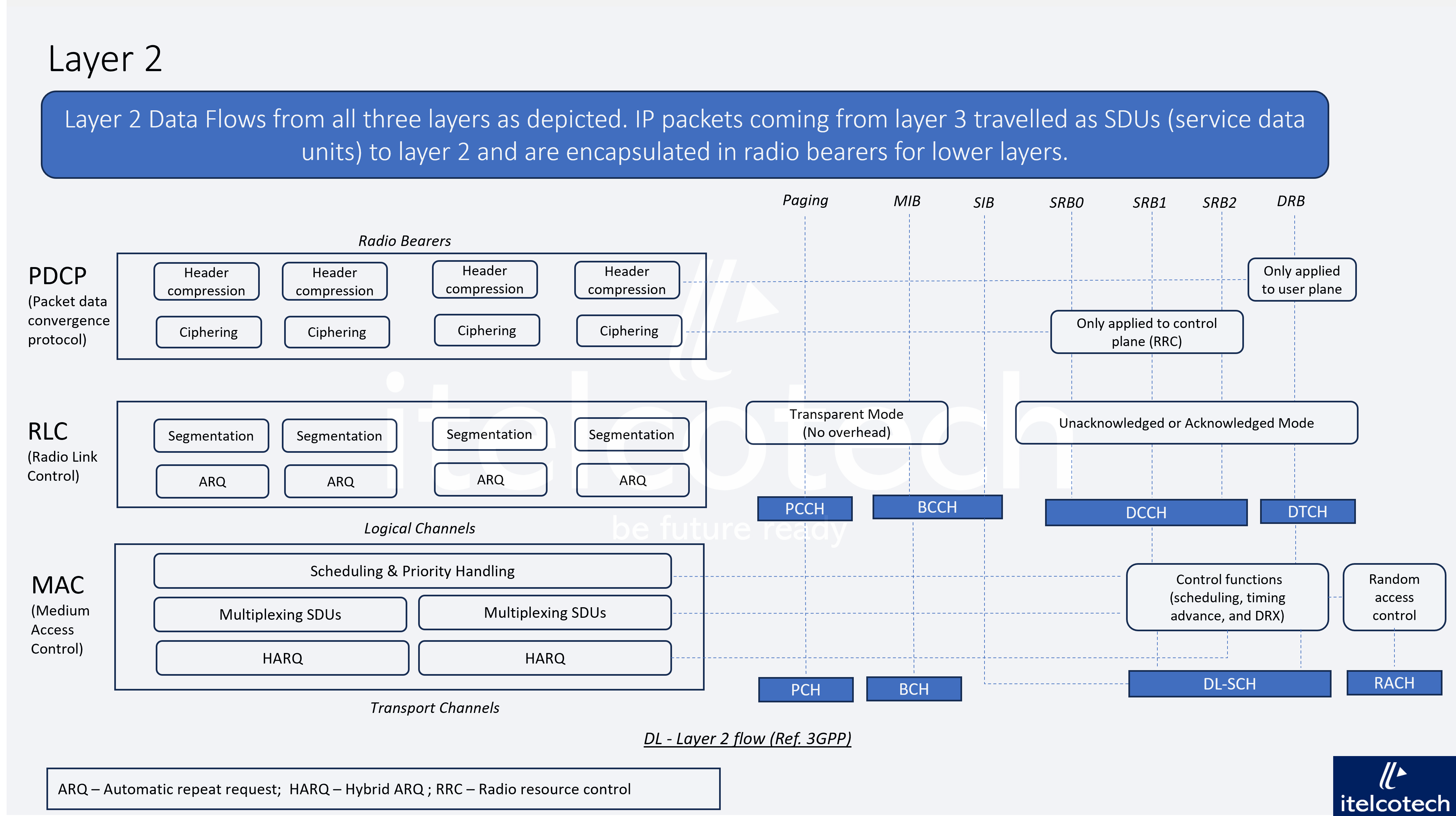
IP packets coming from layer 3 travel as SDUs (service data units) to layer 2 are encapsulated in radio bearers for lower layers. There are three key protocols present at layer 2 as follows :-
1. PDCP (Packet data convergence protocol) provides following services such as :-
• Transfer of user plane & control plane data
• Header compression
• Ciphering
• Integrity protection
2. RLC (Radio link control) acts as an interface and buffer between the higher layers of the protocol stack (usually PDCP in the user plane) and the MAC layer, which has almost no buffering capability and acts more as a router. The following services are provided by RLC:
• Segmentation & Concatenation of SDUs
• Duplicate detection & Error correction through ARQ (Automatic repeat request)
• Timing Alignment - In-sequence delivery - implies that data blocks are delivered by the receiver in the same order as they were transmitted
3. MAC (Medium Access control) has following key functions -
• Random Access Procedure (RACH)
• Scheduling and Radio Resource Allocation
• Error correction through HARQ (Hybrid automatic repeat request)
• Paging and Discontinuous Reception Support
• Quality of Service (QoS) Management
• Aggregation of Carriers
• Control functions (timing advance and Discontinuous reception)
👉 This lecture belongs to RAN Engineering course and to learn more about it, please refer to the complete course at - https://www.itelcotech.com/learningpath/ran-engineer-4g-and-5g