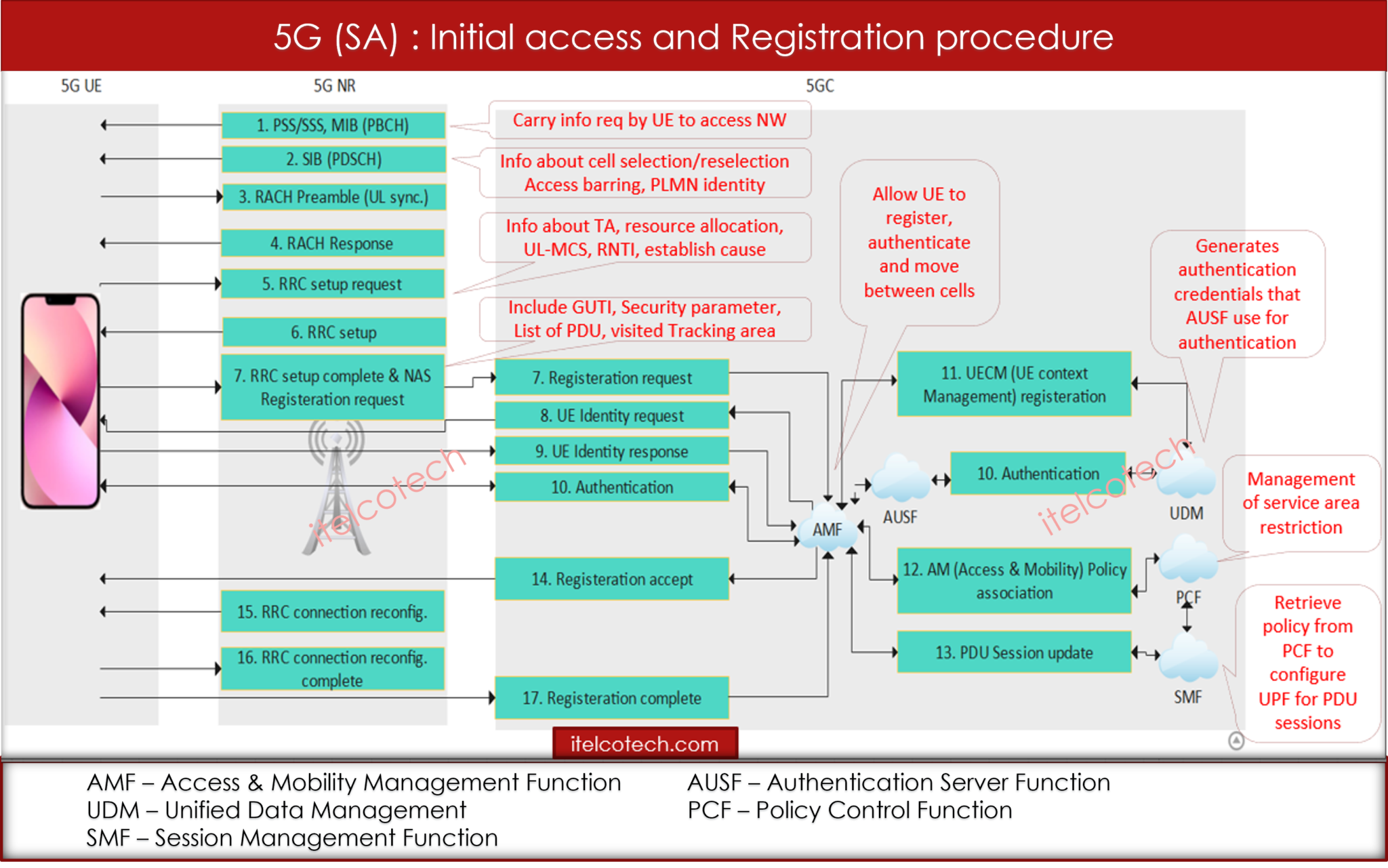
5G: Initial access and Registration procedure
byRahul Kaundalon
UE needs to register with the network to get authorized to receive services, to enable mobility tracking and reachability.
In a case when UE powers ON, initial registration is performed. UE needs to select the network and determine to which public land mobile network (PLMN) to attempt registration.
· Initial access consists of functions where the cell search and acquisition are done at first allowing a UE to synchronize to the target cell. Primary synchronization signal (PSS) and Secondary synchronization signal (SSS) helps to establish DL synchronization.
· The system information (SI) from NR helps UE to acquire the information needed to access the network through Master Information Block (MIB).
· Then System information block (SIB) in DL includes configurations for the UE, such as cell selection/reselection, random access parameters, PLMN identity and access class barring list. Once all criterions are met, cell is selected by UE.
· Initial access from UE to NR starts from Random Access procedure. NR decodes the preamble and UL synchronization is performed.
· Radio resource control (RRC) is setup and then an initial NAS message establish a signaling connection between UE and AMF (5GC).
Attached figure depicts further interactions among network functions in the 5GC upon initiation of the REGISTRATION REQUEST message.
The UE initiates the Registration procedure using one of the following Registration types:
– Initial Registration to the 5GS;
– Mobility Registration Update upon changing to a new Tracking Area (TA) outside the UE’s Registration Area in both CM-CONNECTED and CM-IDLE state, or
when the UE needs to update its capabilities or protocol parameters that are negotiated in Registration procedure with or without changing to a new TA, a change in the UE’s Preferred Network Behaviour that would create an incompatibility with the Supported Network Behaviour provided by the serving AMF, or
when the UE intends to retrieve LADN Information; or
– Periodic Registration Update (due to a predefined time period of inactivity); or
– Emergency Registration.
The following are the cleartext IEs that can be sent by the UE in the Registration Request message if the UE has no NAS security context:
– Registration type
– SUCI or 5G-GUTI or PEI
– Security parameters
– additional GUTI
– 4G Tracking Area Update
– the indication that the UE is moving from EPS.
During the initial registration the PEI is obtained from the UE. The AMF operator may check the PEI with an EIR. The AMF passes the PEI (IMEISV) to the UDM, to the SMF and the PCF, then UDM may store this data in UDR by Nudr_SDM_Update.
NOTE 1: The use of NSI ID in the 5GC is optional and depends on the deployment choices of the operator.
During the registration the Home Network can provide Steering of Roaming information to the UE via the AMF (i.e. a list of preferred PLMN/access technology combinations or HPLMN indication that ‘no change of the “Operator Controlled PLMN Selector with Access Technology” list stored in the UE is needed). The Home Network can include an indication for the UE to send an acknowledgement of the reception of this information.
The AMF determines Access Type and RAT Type based on the Global RAN Node ID associated with the N2 interface and additional the TAI is used to distinguish between broadband (e.g. NR or WB-E-UTRAN) and narrowband (NB-IoT) RAT Types. The RAT Type is used to determine whether the UE is performing Inter-RAT mobility to or from NB-IoT.
The Registration type indicates if the UE wants to perform an Initial Registration (i.e. the UE is in RM-DEREGISTERED state),
a Mobility Registration Update (i.e. the UE is in RM-REGISTERED state and initiates a Registration procedure due to mobility or due to the UE needs to update its capabilities or protocol parameters, or to request a change of the set of network slices it is allowed to use),
a Periodic Registration Update (i.e. the UE is in RM-REGISTERED state and initiates a Registration procedure due to the Periodic Registration Update timer expiry or
an Emergency Registration (i.e. the UE is in limited service state).
Reference – 3GPP