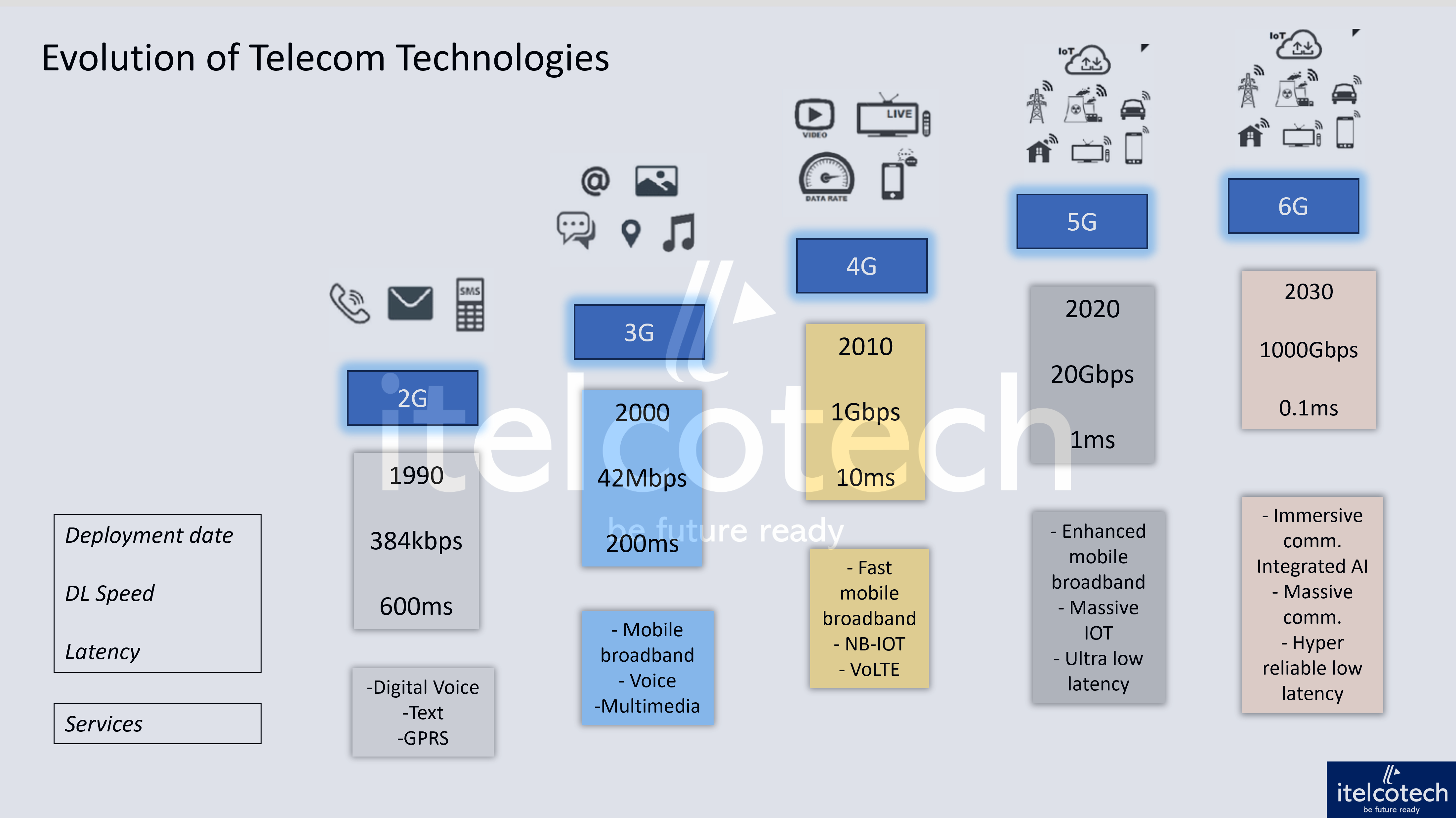
Evolution of telecom technologies 2G 3G 4G 5G
byRahul Kaundalon
Evolution of telecom technologies
The evolution of telecommunications technologies from 2G to 6G has been marked by significant advancements in speed, capacity, latency, and the types of services supported. Here's a brief overview of each generation:
2G (Second Generation):
Introduced in the 1990s, primarily for voice calls and limited data transmission.
Mainly relied on digital technologies like GSM (Global System for Mobile Communications) and CDMA (Code Division Multiple Access).
Provided basic data services like SMS (Short Message Service) and limited internet access (GPRS).
3G (Third Generation):
Rolled out in the early 2000s, offering faster data speeds and better support for multimedia applications.
Enabled services like video calling, mobile internet, and mobile TV.
Technologies included UMTS (Universal Mobile Telecommunications System) and CDMA2000.
4G (Fourth Generation):
Emerged around 2010, providing significantly faster data speeds and lower latency compared to 3G.
Enabled high-definition mobile video streaming, online gaming, NB-IOT and other data-intensive applications.
5G (Fifth Generation):
Began commercial deployment around 2019, offering ultra-fast data rates, extremely low latency, and massive device connectivity.
Enables advanced applications like virtual reality (VR), augmented reality (AR), Internet of Things (IoT), and autonomous vehicles.
Utilizes technologies such as millimeter-wave spectrum, massive MIMO (Multiple Input Multiple Output), and network slicing.
6G (Sixth Generation):
Still in the conceptual and early research phase as of the recent updates.
Expected to offer even faster data rates, lower latency, and more reliable connections than 5G.
Envisaged to support technologies like holographic communication, terahertz frequency bands, and AI-driven networks.
Likely to enable further integration of AI and machine learning into telecommunications networks, leading to more efficient resource management and personalized services.
Each generation builds upon the previous one, addressing shortcomings and introducing new capabilities to meet the growing demands of users and applications. The transition from one generation to the next typically involves significant infrastructure upgrades, spectrum allocation, and standardization efforts by industry stakeholders and regulatory bodies.
**To learn about telecom technologies right from the basics - refer to the course on Telecom Technologies essentials -
https://www.itelcotech.com/learningpath/telecom-essentials-2g-to-5g