Network Function Virtualization, Management & Orchestration (NFV, MANO – 5G)
byRahul Kaundalon
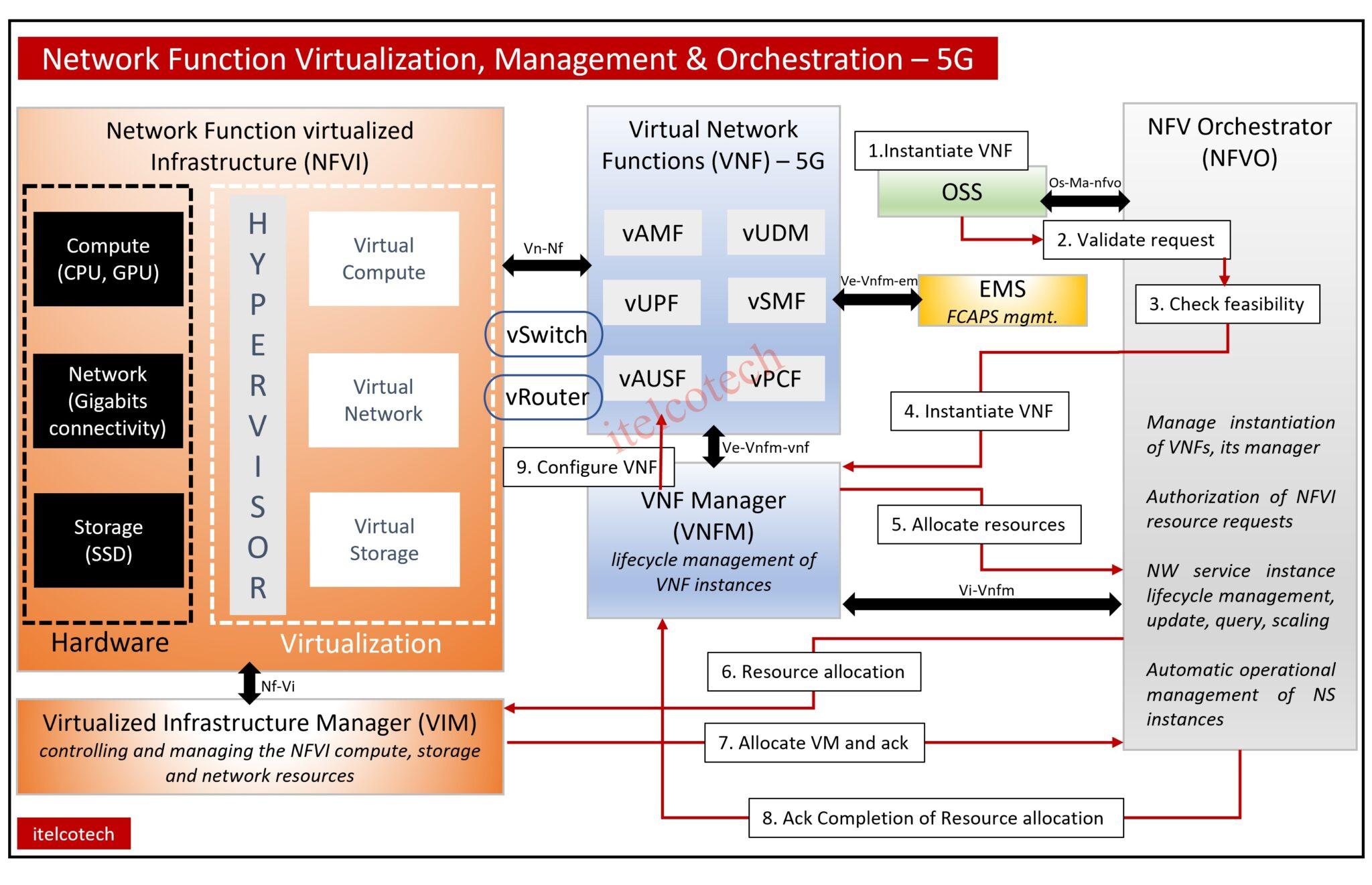
Network Functions Virtualization (NFV) decouple infrastructure from the different 5G network functions virtually.
Infrastructure with physical nodes for compute, networks and storage are virtualized using hypervisor makes virtual machines known as NFV Infrastructure (NFVI).
NFVI resources such as compute, networks and storage are controlled and managed by Virtualized Infrastructure Manager (VIM).
Network functions such as 5G core node functions can be deployed on the underlying virtual machines known as Virtual Network Functions (VNF).
Lifecycle management of these functions such as Instantiate VNF (create a VNF using the VNF on-boarding artefacts), Scale VNF (increase or reduce the capacity of the VNF), Update and/or Upgrade VNF (support VNF software and/or configuration changes of various complexity), Terminate VNF (release VNF-associated NFVI resources and return it to NFVI resource pool) are managed by VNF Manager (VNFM).
Network Service Orchestration coordinates the lifecycle of VNFs that jointly realize a Network Service. It is responsible for the Network Service lifecycle management including operations such as: • On-board Network Service, i.e., register a Network Service in the catalogue, • Instantiate Network Service, i.e., create a Network Service using the NS on-boarding artefacts, • Scale Network Service, i.e., grow or reduce the capacity of the Network Service, • Update Network Service by supporting Network Service configuration changes of various complexity such as changing inter-VNF connectivity or the constituent VNF instances, • Terminate Network Services, i.e., request the termination of constituent VNF instances, request the release of NFVI resources associated to NSs, and return them to NFVI resource pool if applicable.
The Network Service Orchestration performs its services by using the VNF Management services and by orchestrating the NFV Infrastructure that supports the interconnection between VNFs functionality, and its functions are exposed in an open, well known abstracted manner as services to other functions.
The services provided by Network Service Orchestration can be consumed by authenticated and properly authorized other functions (e.g., Operations Support System (OSS).
Note: Here virtualization involves proprietary software functions and Infrastructure as a service with a granularity of virtual machines. Going forward cloud native solution with the granularity of containers/dockers and introduction of Kubernetes will help to provide more flexibility, scalability, and efficiency with some challenges for telcos and will be discussed in upcoming posts. Reference – ETSI