Power Control (UL) - 4G
byRahul Kaundalon
Power Control (UL) - 4G
Power control in Uplink helps to improve efficiency by reducing inter‐cell interference and UE power consumption.
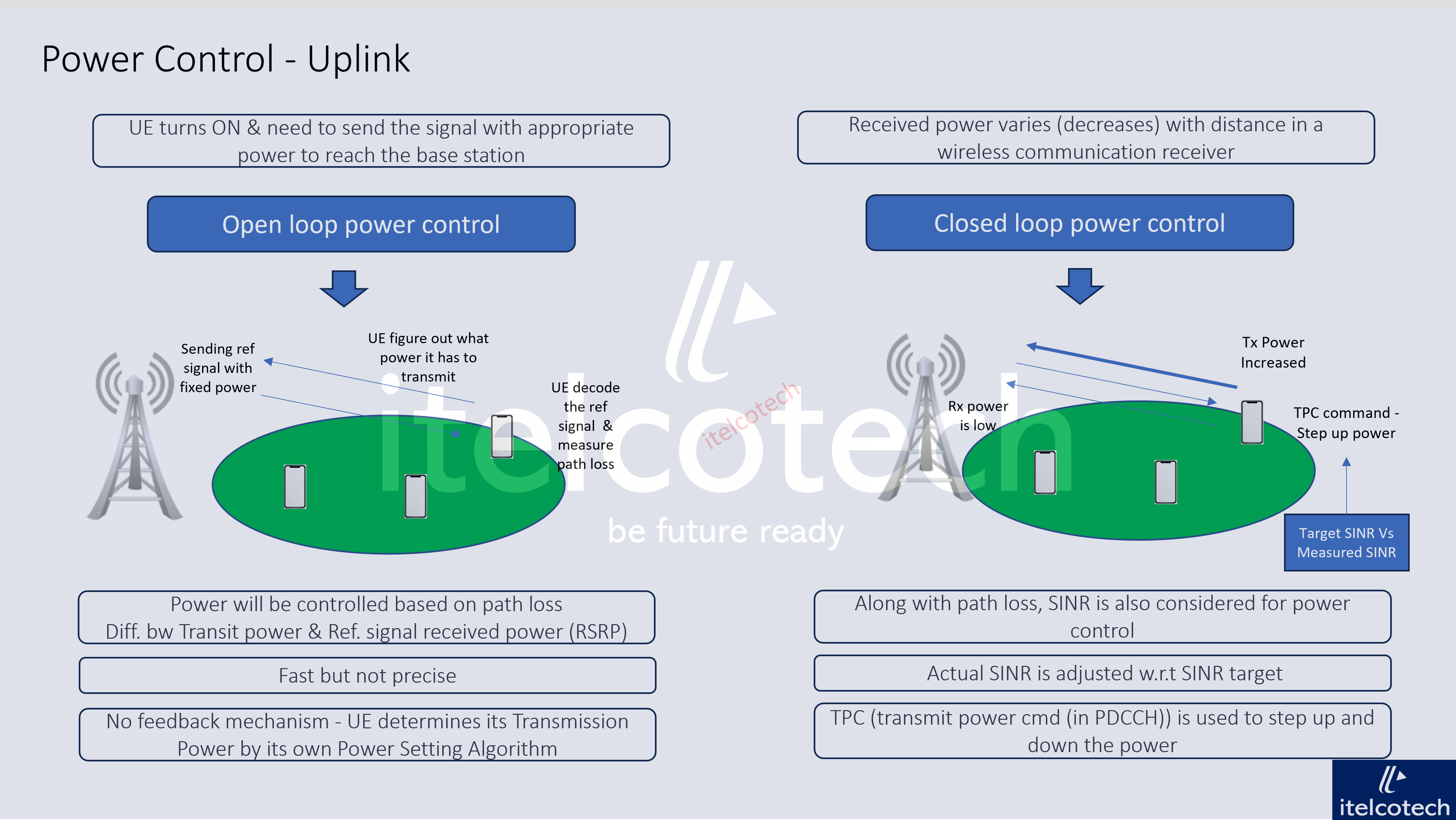
When UE is powered up first time, Open‐loop power control is applied for initial transmission here. Power here is controlled based on the path loss difference between transmit power and received power (Reference signal received power – RSRP). Open loop mechanism is faster but not precise and there is no feedback mechanism is used to change the power. UE determines the power changes based on the set algorithm.
After initial setup, with the change in the distance between UE and base station, SINR along with path loss is considered for power control and here comes closed loop power control mechanism in the picture.
Power control of PUSCH is based on open‐loop power control with slow aperiodic closed loop correction factor, it is based on fractional pathloss power control. With fractional pathloss power control, it will be easier to set power control parameters that will enable higher UL peak rate in the cell without sacrificing cell‐edge performance. It enables a trade‐off between maximized UL cell edge bitrates versus improving the overall UL cell capacity.
Power control of PUCCH is based on SINR as there is no link adaptation and fixed MCS is used over PUCCH. The UE‐received PUCCH SINR will be compared with the target PUCCH SINR and TPC values will be generated based on the difference between the two values.
To learn about 4G end to end, refer to the 4G course at - https://www.itelcotech.com/learningpath/4g-architecture-design-call-flows-kpis-and-optimization