Random Access Channel (RACH) & its parameters - Optimization
byRahul Kaundalon
RACH & its parameters
PRACH is used for the initial access procedure, allowing a UE to establish communication with the network
PRACH (Physical Random Access Channel) transmit power refers to the strength or intensity of the signal transmitted by a user device (UE) when initiating the Random Access procedure.
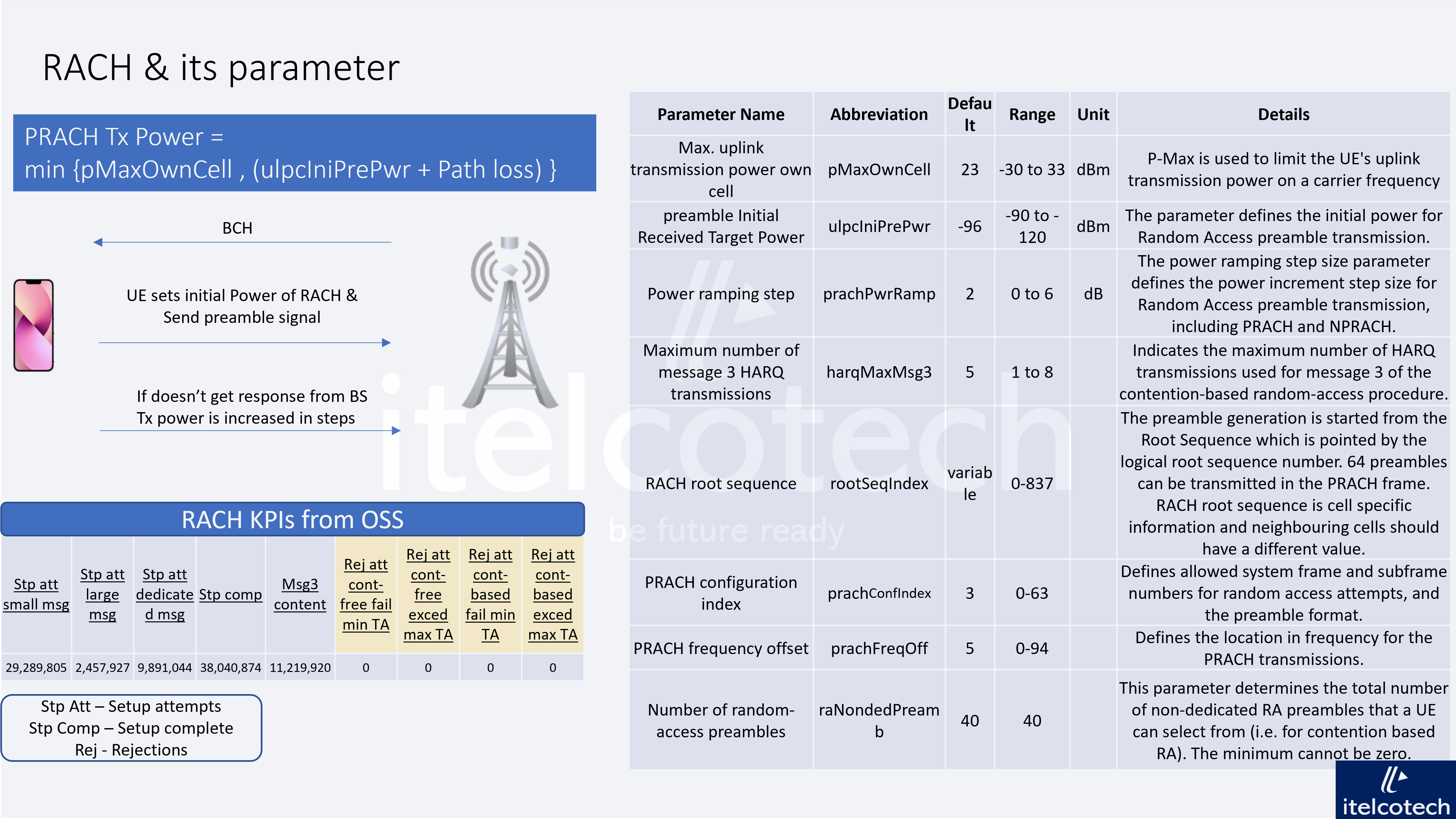
PRACH Tx Power = min {pMaxOwnCell , (ulpcIniPrePwr + Path loss) }
Max. uplink transmission power own cell : P-MaxOwnCell - is used to limit the UE's uplink transmission power on a carrier frequency
Preamble Initial Received Target Power : ulpcIniPrePwr - The parameter defines the initial power for Random Access preamble transmission
UE sets initial Power of RACH & Send preamble signal and if doesn’t get response from BS
Tx power is increased in steps.
Power ramping step : prachPwrRamp - The power ramping step size parameter defines the power increment step size for Random Access preamble transmission.
LTE networks employ power control mechanisms to optimize the transmit power levels of the PRACH preamble. The goal is to ensure that the signal is detectable by the eNB without causing interference to other UEs or neighboring cells.
The precise configuration and control of PRACH transmit power contribute to the efficiency and reliability of the Random Access procedure. Controlling power levels ensures that the PRACH preamble is reliably detected by the eNB, facilitating synchronization and successful establishment of communication between the UE and the network.
** To learn more about such topics, refer to the course on RAN Engineering at - https://www.itelcotech.com/learningpath/ran-engineer-4g-and-5g