System Information Block & Master Information Block– RRC
byRahul Kaundalon
System Information Block & Master Information Block– RRC
It is imperative to regularly provide the information about the network towards User equipments (UE) so that UE can decode that information appropriately to initially connect (attach) to the network & then maintain that connection seamlessly.
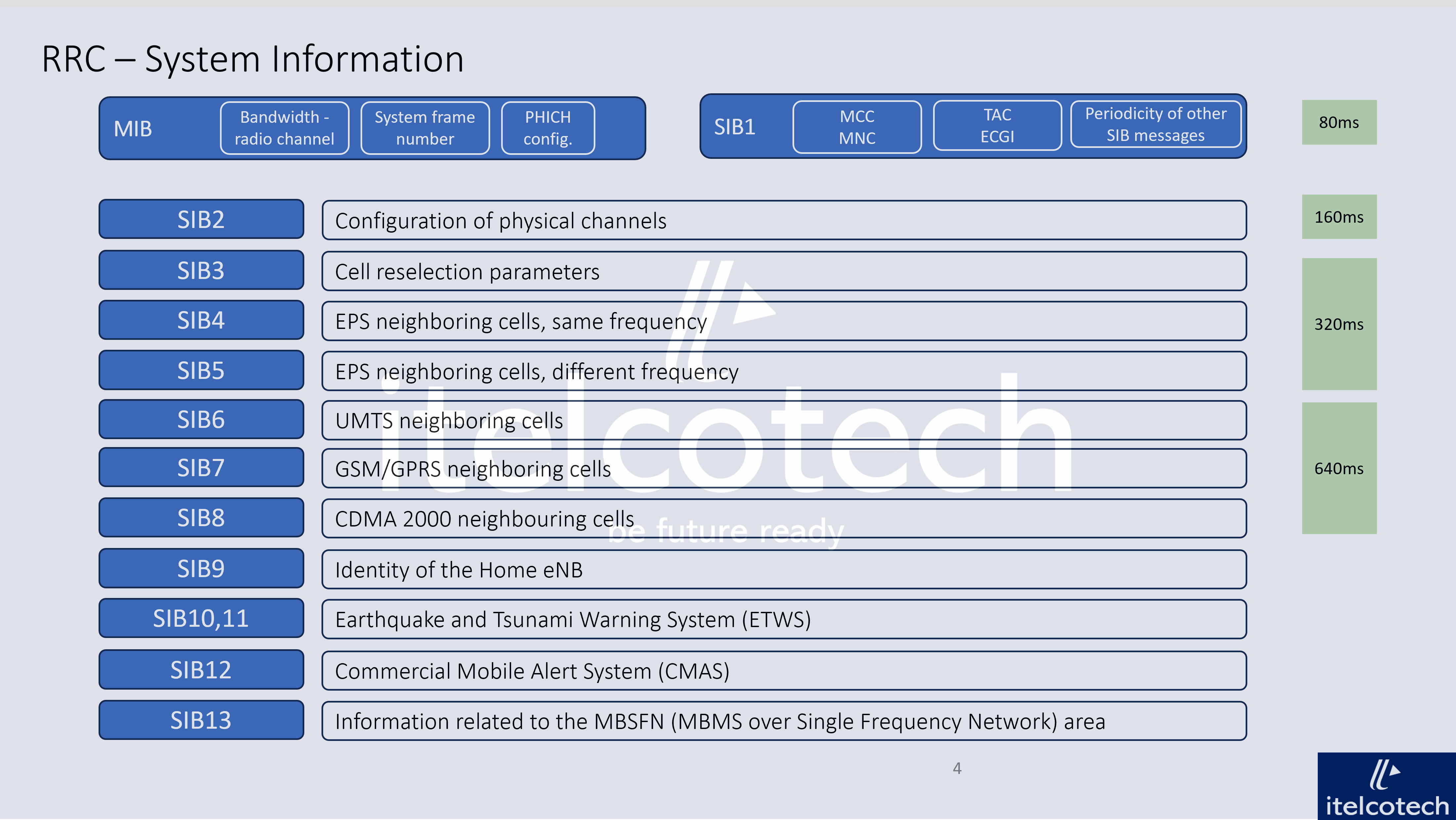
Different set of information are transmitted regularly in terms of System Information (SI). It include one master information block (MIB) and multiple system information blocks (SIB).
MIB is used initially to give information about carrier bandwidth, system frame number to sync UE with the network in downlink and indication about the hybrid automatic repeat request (HARQ) for error detection & correction. It is transmitted every 40ms to the UEs.
There are multiple SIB messages including primary SIB1 message that tells UE about the mobile country and network code so that UE selects the right network to which it got the SIM from. It also contains the granular information about tracking area & cell to which user is attached. It transmits every 80ms in downlink.
SIB2 messages informs users about the cell range through preamble and indicates the location of channels related to initial access so that UE can decode the right set of resources in time and frequency domain using configuration index. It also informs UE about the different timers defined in the network to maintain radio link.
Once use is attached to the network, it is imperative to inform the UE about the criteria defined in the network when to move from serving cell to neighboring cell either in the same or different technologies. Such information is encapsulated in SIB 3,4,5,6,7.
Some of the other key SIB messages are mentioned below.
👉 This lecture belongs to course on Protocols & Simulation in 4G and link for the course is - https://www.itelcotech.com/learningpath/4g-architecture-design-call-flows-kpis-and-optimization